From start-up to gamechanger
How Jurrian Knijtijzer has been revolutionizing construction with Finch Buildings for 10 years.
In 2014, Finch Buildings, developer of wooden building modules, unleashed a revolution in construction, after which the start-up grew into an established name. How did founder Jurrian Knijtijzer manage that, and what plans does he have for the future?

"We want to make building with wood very common," says architect and concept developer Jurrian Knijtijzer. Just as the invention of Lego revolutionized the toy world early last century, Knijtijzer wants to revolutionize the construction industry with his company Finch Buildings. Ten years ago, he developed a durable wooden building module, which you can switch and stack - like life-size Lego blocks - into buildings of all shapes.'
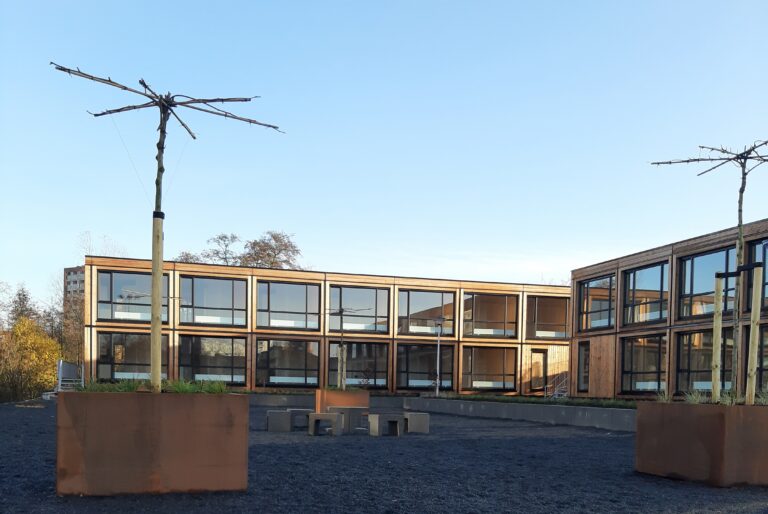
Among other things, he used it to build his own house in Amsterdam North, composed of three stacked modules enveloped by a glass greenhouse. A little further on, he realized a striking seven-story building with 22 apartments and a facade of unpainted wood, which is slowly aging. The largest project built with Finch modules to date is currently rising in Haarlem; it comprises three residential blocks with 179 apartments and office space, and was designed by FARO around a communal courtyard garden.
Acceptance of wood construction
Finch Buildings now has 16 employees and operates three factories, producing 1,100 modules in ten years, completing 14 projects, and: 25,000 tons of CO2 has been stored and saved. Knijtijzer: 'I am immensely proud of that, even though we have built less than I thought we would ten years ago - and I think ten steps ahead now. At the same time, I realize that we have done more than build: Finch Buildings has helped shape the acceptance of timber construction in the Netherlands.'
Until after World War II, building with wood was the norm, with buildings - thanks to wooden mortise and tenon joints - being naturally dismountable and reusable. With the advent of industrial construction, steel and concrete came into vogue; with them, buildings could be built faster, taller and bigger. That the production of these materials has an enormous - negative - impact on the climate only became clear later.
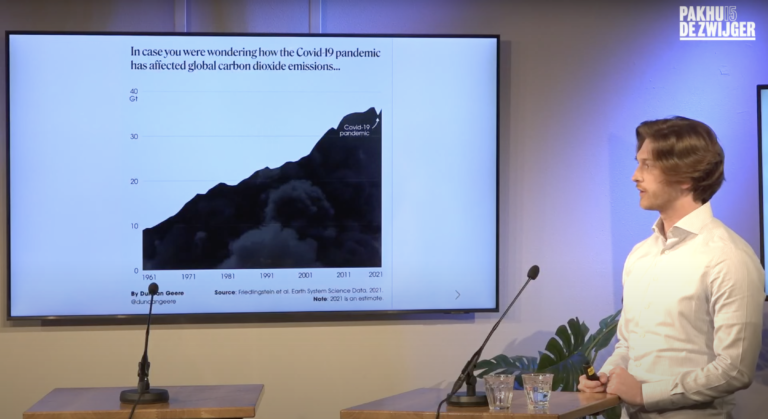
With Finch Buildings, Knijtijzer wants to turn the tide, working with modern techniques and certified cross-layer lumber. With which you can build fast, big and tall, while reducing CO2 is stored rather than emitted. 'Construction must take that step quickly now if we are to meet the climate goals of the Paris Agreement; the goal is to reduce CO2-emissions by half in 2030 compared to 1990. Knijtijzer shows a graph of the targeted reduction along with the current CO2-emissions from construction: a line that is only very slowly tapering off. 'If the sector continues on its current footing (and it does), by 2027 CO2-budget already exceeded.
Sustainable dream
What drives this passionate entrepreneur, who sets the sustainable bar exceptionally high and seems to take the hurdles on the way there for granted?
He had an interest in nature and the built environment even as a child. 'I was into critters, a member of the World Wildlife Fund - and I come from a family of architects,' Knijtijzer says. 'My grandfather was an architect, my father a builder and interior designer. I initially set myself against that, by visiting the open day of an economics school. But I didn't like that, so I went on to study architecture at the HTS and then at the Amsterdam Academy of Architecture.' During that time he worked at various architectural firms, while dreaming of his own firm, with which he would realize sustainable projects.
In 2006, he saw the documentary An Inconvenient Truth by Al Gore, which made a deep impression. A few years later, the film Waste = Food on the Cradle to Cradle concept of American architect William McDonough and German chemist Michael Braungart. 'It gave me insight into how the construction industry contributes to climate change, and - vice versa - can help find solutions to it,' Knijtijzer said.
The idea to do so using a modular building system came about when, in 2007, working as a project manager at architectural firm HVDN, he was commissioned by housing corporation De Alliantie in Hilversum to design a residential care building using a modular building system of steel, wood, and concrete. It was a bold plan, Knijtijzer explains. 'The building modules had been developed for temporary housing, and were applied in a care building for a vulnerable target group. I saw more possibilities for this; the building system worked quickly, was relatively cheap, and the units could be reused and moved.'
Staying naive
A few years later - Knijtijzer had decided he was going to start his own business - he called De Alliantie's client, Marinus Knulst, to visit the building for a reality check. "I was shocked by the poor structural condition, and knew: if I want to continue with module construction, the quality has to be better. He approaches several module builders to present his ideas for innovation, but gets zero response; they don't want to question their product. The eureka moment comes when he stumbles upon a new building material: cross-layer timber (CLT). 'That is not only of much higher quality than traditional modular building systems, but also sustainable, because in wood CO2 is stored,' Knijtijzer explains. 'Wood is also a healthy, breathable material, which is pleasant to the touch and smells good.'
Unhindered by ambition, he devises to develop his own building modules with CLT in order to use them - with a corporation that he will set up himself - to build housing. Knijtijzer: "I saw college friends leaving Amsterdam because they couldn't find affordable housing; I wanted to do something about that. But I had no idea what was involved. The common thread throughout my career is that I deliberately set myself up to be quite naive. Marinus Knulst taught me that, above all, I should stay that way; otherwise you'll never start anything new. But he also said that I wanted too much at once.'

Thus, Knijtijzer decides to focus on producing the wooden modules; that is the beginning of Finch Buildings. He finds a company to fund his start-up, and a wood factory, which can make and screw together the CLT elements. With that, he produces the first four Finch modules, which he presents in 2016 at Amsterdam's Fab City Campus for sustainable innovations in construction. He lives there himself for three months, and has his office there. "That was a great experience, where I got a lot of positive publicity and reactions from visitors," Knijtijzer says.
Pragmatism
A Leiden housing corporation read about it and called with the order for 16 temporary housing units. 'That was the beginning of something bigger, although the opening day was also an immediate low point. In the morning I received a photo on my cell phone showing flames near the building. I thought: this is the end of the story, but when I arrived, it turned out that presumably local residents had tried to start a fire, as a protest against the arrival of the temporary residents. The facade held up well; the fire department and my client were impressed. The wood building modules proved themselves in practice.'
But no new clients immediately came forward. 'Because of the economic crisis at the time, little was happening in housing construction. In addition, my product proved difficult to sell. I had opted for triple glazing, biobased insulation, energy-efficient low voltage and a 2.80 m high ceiling; 20 cm more than the legal minimum height. A module of top quality, but even more expensive than traditional housing construction.'
Realizing that he is not going to make the intended impact with this, he comes to a compromise. 'I reduced the building system to the qualitative lower limit, with 2.60 m ceiling height, plastic window frames fitted with double glazing, and plain AC. Later we replaced the walls of solid cross-layer wood with a column-girder structure. That saves material, and it allows you to easily insert and remove partitions in the house, which makes the system flexible.' The result: a sustainable residential product that can compete with traditional construction.
Learning capability
Major projects then present themselves. On the Koelmalaan in Alkmaar, Finch is building a complex of 129 social and mid-rent homes with 260 modules. 'It was a complicated inner-city location, with a lot of noise pollution. We absorbed that with a glass screen, while the facades are in (stone-strip) brickwork, so that the blocks match the brick buildings in the area.'
Knijtijzer calls the De Tuinfluiter project in Heerhugowaard "an important learning experience. 'Until then, we did all projects together with one factory, which entailed a certain dependency. For this project, we worked with another factory for the first time, where we took on - in addition to the design - also the execution on the building site, together with a contractor. We already had a lot of theoretical knowledge, here we learned everything about construction practice. Then we started working more with other architects, so that we could focus on what we do best: making beautiful modules.'

Using reference projects, Knijtijzer shows the variation that is possible: gallery, corridor or core access, extra-high or wide modules, coupled to form a straight and angular structure, or with sloping facades, such as the iconic live/work building that Finch will build in Leeuwarden together with Achterbosch Architects. 'We can serve multiple target groups with different uses; the starting point was to use one module to build homes as well as offices, healthcare buildings and hotel rooms.'
Piloting role
In response to increased demand for fast, affordable housing, more construction companies have turned to module construction. 'What sets Finch apart is the expertise we have built up over ten years,' says Knijtijzer. 'We have already done many projects and gone through many processes; we don't need to reinvent the wheel. What is unique about this is our independent position; we do not operate from our own factory, but seek smart cooperation with existing parties. What we offer is a modular system and advice on the design and construction process. The client chooses the architect, the factory and the builder.'
'Many clients want to make the switch from concrete to wood construction, but find that quite a puzzle. We help them lay it out, as a link between contractors, module producers and architects.' Knijtijzer makes the comparison with a seagoing ship where a pilot boat brings a pilot on board, who guides the ship safely to port. 'That is our role: to guide building parties to feasible timber construction projects. In doing so, we - inspired by Darwin's theory of evolution - continue to develop the module, responding to the needs of the place and possibilities of technology.'

Finch can now stack modules up to 13 layers, and produce faster and faster. In Amsterdam, the company won a tender where 120 homes will be built in six months. Because bio-based materials are slowly becoming commonplace - and therefore cheaper - the insulation will eventually also be made standard with them. In addition, the aim is to move more and more in the direction of passive construction, in which installations will become superfluous.
Gamechanger
Finally, he points to the introduction of certificates for CO2-storage, which are issued by climate foundation Climate Cleanup and can be traded. Each ton of CO2 which is not emitted but stored, thereby becoming worth money. 'That's going to be a gamechanger,' Knijtijzer grins. With the project in Alkmaar, his company was the first to have such a CO2-certificate obtained. The price was calculated at 150 euros per stored ton of CO2, or 3,000 euros per home.
'Next year, the first transaction of CO2-certificates granted to our product take place; we are in talks with a major company about that,' says Knijtijzer. 'In other words, these CO2-marketplace already exists, and I dare say in five years there will be a CO2-based construction industry is. In the long run, it means building with wood is a nobrainer.
Finch is in a good position to start making that happen. "Let clients call us; we're ready," Knijtijzer says. His ultimate goal is for Finch to become more than a developer of wood building modules: a generic name for wood building. Knijtijzer: 'Compare it to a Jeep, where people no longer think of the automaker but immediately envision an off-road vehicle. It would be great if, in a while, building parties no longer think: let's invent a wood building system together, but: let's 'just' use Finch modules.
Text: Kirsten Hannema
Photo Jurrian Knijtijzer: Nick Gammon
Photos projects: Kees Hummel
Render: FARO