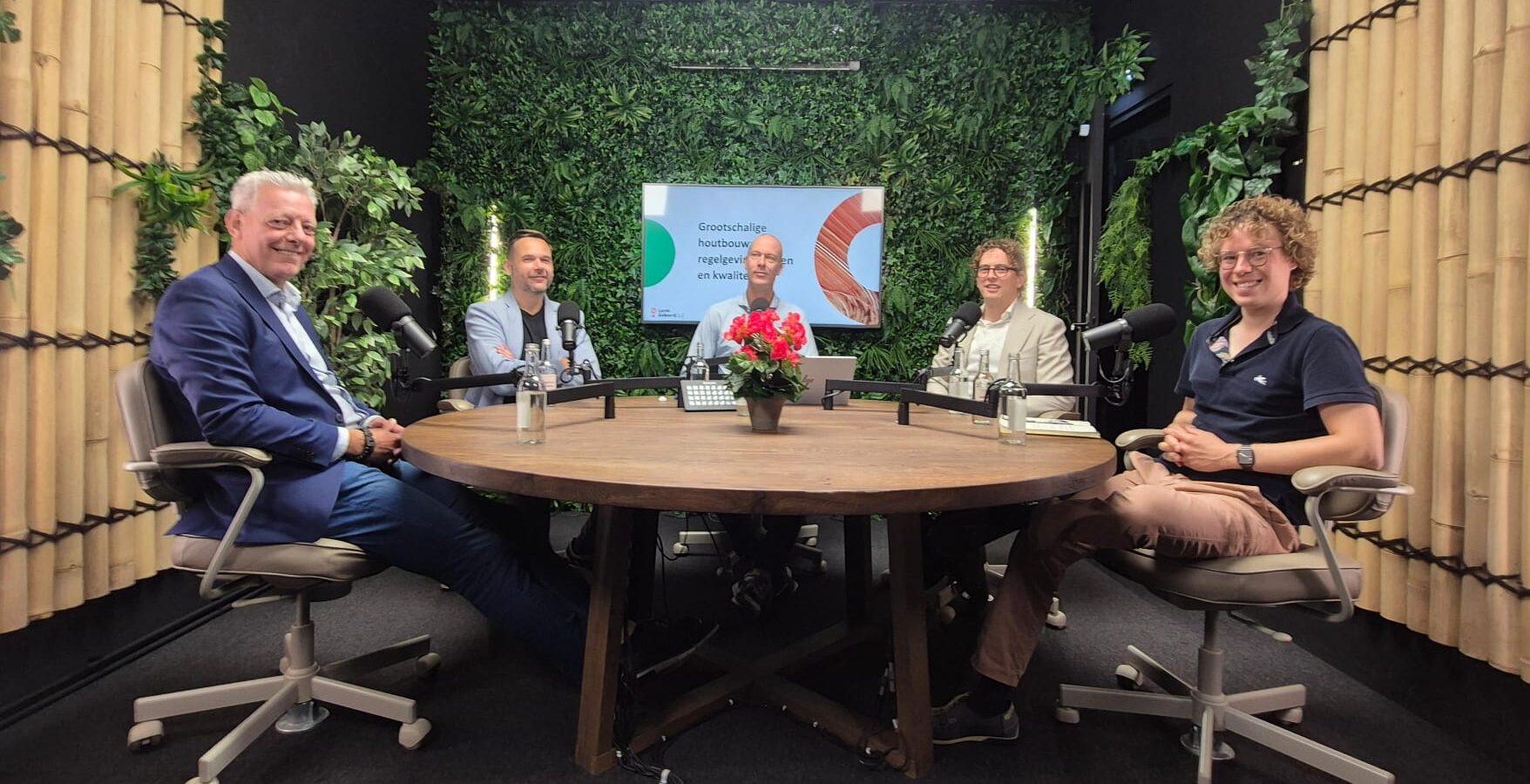
On Sept. 1, 2025 Jurrian Knijtijzer names Finch Buildings participated in the Spring Agreement webinar Large-scale timber construction: regulations, costs and quality.
Read Berber Bijma's report here, published on spring-akkoord.nl on 3-9-2025.
Large-scale timber construction: an excellent business case
Wooden apartment buildings or row houses are slowly becoming more common. And have an excellent business case. It does require a different way of thinking, for example by pricing CO2 storage and time savings.
What have we learned from large-scale timber construction projects completed in the Netherlands in recent years? That question was the focus of the webinar on Sept. 1, 2025, led by Sander Woertman, program leader of Spring Agreement 2.0. The other participants were:
- Jurrian Knijtijzer, founder and director of Finch Buildings
- Tomas Peeters, consultant at Copper8
- Ernest Kuiper, acquisitions developer at housing corporation Woonwaard
- Joost Bruijn, area developer at municipality of Dijk en Waard
Business case
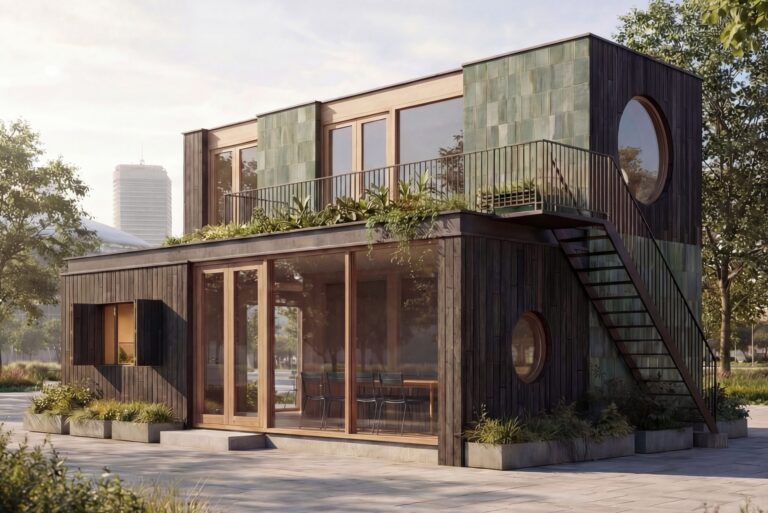
Finch Buildings has been committed to making wood construction as common as possible since 2014, Knijtijzer outlined. 'We see that the timber construction industry is like a puzzle that is still missing pieces. Clients struggle with the business case, architects struggle with wood building designs, factories and contractors puzzle with realization. We are trying to be the missing piece of the puzzle for all those parties and thus ensure that there are more wood construction projects.'
That timber construction has future prospects, Knijtijzer has no doubt. We need to reduce CO2 emissions, use materials much more circularly and build more efficiently in view of personnel shortages. 'In short, we have to build differently from the complex way we do it now, with all kinds of disciplines coming together on the building site.' Modular construction, under controlled conditions in factories and with a relatively short assembly time outdoors, is therefore by far his preference.
With Carbon Credits, you as a developer could recoup as much as 2,500 euros per apartment.
Building with wood not only offers climate benefits. Knijtijzer: "Wooden buildings are healthier. There have been measurements of children in schools performing better in wooden classrooms. In wooden healthcare facilities, absenteeism decreases. With benefits like that, you quickly recoup the few percent higher construction costs.' The same, he says, applies to the financial benefits of detachability and thus the potential for future reuse.
The business case also lies in sequestering CO2, Knijtijzer argues. 'In Alkmaar, for example, 2,100 tons of CO2 were stored in a timber construction project. If you price that at 150 euros per ton, as a developer you would recoup 2,500 euros per apartment.'
Carbon credits
How does that actually work, making money from capturing CO2 in timber projects? Tomas Peeters addressed that question. "In fourteen timber construction projects, we have now stored 25,000 tons of CO2. At a price of 100 to 150 euros per ton stored, that amounts to 3.75 million euros in additional value created by this method of construction.'
The market for carbon credits in wood construction is still in its infancy, says Peeters, but it can certainly contribute to the business case. Carbon credits arise from the use of biobased materials that capture CO2. 'For the stored CO2 you can apply for credit, which you can then offer to parties who want to offset their emissions.' The first real carbon certificate for a natural house by Ballast Nedam has now been traded at real estate fair Provada.
Carbon credits do not offer the buyer a license to emit CO2 unrestrainedly, Peeters emphasizes. 'Not all parties can just buy carbon credits. There must be a clear reduction in emissions. Carbon credits are therefore not a form of greenwashing, but a means to accelerate the transition to a green future.
Where does the merit of carbon credits end up, discussion leader Woertman wondered. That is still a point of discussion. Knijtijzer believes that, in principle, the merit should lie with the end customer, who has stuck his neck out by commissioning a timber construction project.
At the beginning of the chain, for example with the forester, is also conceivable. 'The most important thing is that you avoid double counting.' That is guaranteed in the certification, says Peeters. 'Part of the certification is making transparent where credits have already been claimed, so that they are not claimed again. That gives confidence to the market.'
For housing associations, carbon credits are very attractive, argues Ernest Kuiper. Nevertheless, Woonwaard is still cautious about selling carbon credits derived from timber construction projects. 'We work within the frameworks of the Housing Act and there is still a magnifying glass on the finances of housing associations. Together with 23 corporations and our umbrella organization, we are now looking at whether and how we can fit this in.' Ideally, Kuiper would like to see municipalities purchase the carbon credits of housing corporations. 'Then you have a very nice story and a good example for other projects.'
Deliver in one year
One financial advantage of wood construction that is still often overlooked is the speed with which a project can be realized. With that speed, there are fewer interim increases in interest and material costs. Also (expensive) interim solutions for people who need a home in a hurry are less often needed.
The De Klamp neighborhood in Heerhugowaard is a great example of that speed. During the seminar, Ernest Kuiper and Joost Bruijn told how that timber construction project took shape. Within a year, 59 social housing units were realized, from first phone call to completion. The homes are intended for Ukrainian refugees, among others.
The question is: Are you a decision-maker or an influencer? Do you have the guts to put your ambition on the table and stand your ground? That makes all the difference.
Bruijn: 'De Klamp came into the picture as a successor to a location we could only rent for ten months for the reception of Ukrainians. If you have to realize something within ten months in a place where nothing has been built yet, you need each other very much.'
The project gained momentum as all parties involved, including Finch Buildings, met weekly. Officials involved were invited to the table in turn, which greatly shortened the sometimes long journey past municipal offices. 'We took risks,' says Bruijn, 'but we shared them with the municipality, housing corporation and suppliers. I think that is quite unique.'
For Kuiper, collaboration with the municipality was crucial. 'For a project like this, you need people with guts. The question is: Are you a decision-maker or an influencer and do you have the guts to put your ambition on the table and stand your ground? That makes all the difference. This project was up and running within a year, but a year and a half is still very fast too. On average, a construction project in the Netherlands takes seven years from idea to realization.'
The benefits of speed should not be underestimated, Knijtijzer believes. 'Operating in a pressure cooker is an important lesson. Then you have less chance of delays and price increases due to external factors. That requires a lot of energy, but if it works, you see that there are many more benefits: faster rent payments, less interest and investors who can put their money to work faster.'
Text: Berber Bijma
Copper8 publication: CO₂ sequestration in biobased building materials
Finch publications: Downloads